Topic-level comparison: Overlaps vs New / Changed
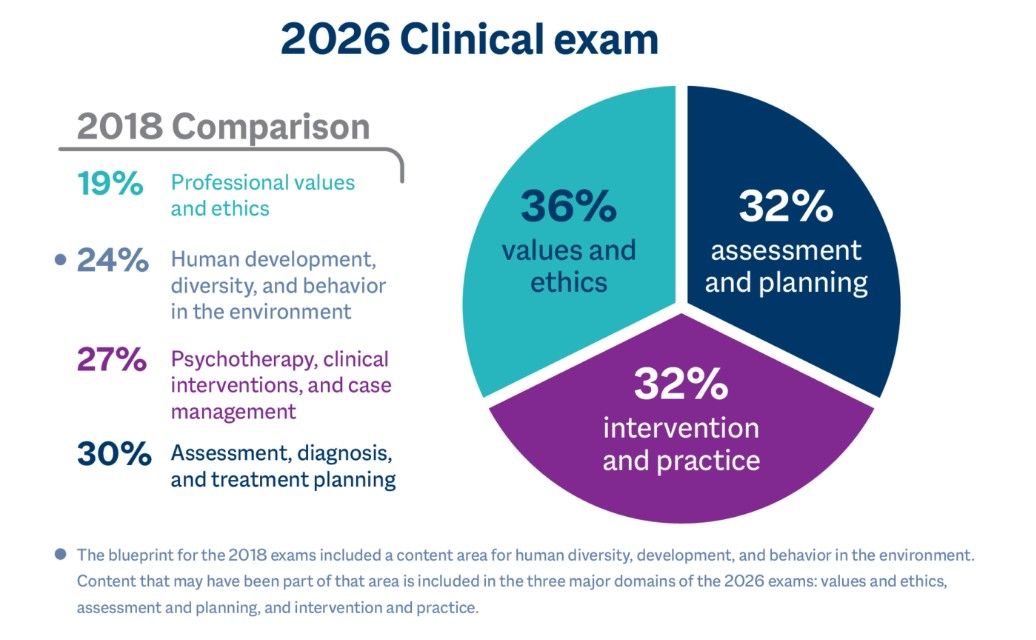
I. Values, Ethics, Diversity / Social Justice (2026) vs. “Human Development, Diversity, Behavior in the Environment + Professional Values/Ethics” (2018)
Because the 2026 first area merges what used to be partly domain I (development, diversity) and domain IV (ethics) into a “Values & Ethics / Diversity / Social Justice” domain, many of the 2018 human development / diversity topics are redistributed into this first domain or into the new “Assessment & Planning” or “Intervention & Practice” domains.
Significant overlapping topics (persisting in some form):
Ethical principles, responsibilities, dilemmas, confidentiality, professional boundaries, mandatory reporting, documentation, termination, self-disclosure — these are clearly incorporated in IA Ethical Principles & Responsibilities and IB Ethical Service Delivery in 2026.
Professional values, self-care, burnout, secondary trauma, compassion fatigue — 2026 explicitly includes these under ethics.
Self-determination, limits on client choice (e.g. refusal of treatment) — appears in “Ethical Service Delivery.”
Legal / ethical issues in documentation, termination, death/dying — present in 2026.
Research ethics / informed consent / human subjects — in 2026’s ethics domain.
The effects of culture, race, ethnicity, gender, sexual orientation, intersectionality on identity and behavior — 2026 covers these under Diversity & Social Justice subdomain (IC) (e.g. “impact of culture, race, ethnicity, sexual orientation, gender, and intersectionality on behaviors, attitudes, and identity formation”).
Concepts of privilege, implicit bias, microaggressions, power differential, and racial privilege — these are newer or expanded emphases in the 2026 outline under Diversity & Social Justice.
Globalization, immigration, refugee / undocumented status — 2026 mentions “Impact of globalization, immigration, and refugee or immigration status on clients/client systems and service delivery” under Assessment & Planning (IIA) but also likely part of diversity thinking.
Accessibility, translation/interpretation, neurodiversity — appear as newer or more explicit elements (under diversity in 2026).
New or expanded emphases in 2026:
Anti-oppressive / anti-racist approaches, truth & reconciliation, restorative practices — these are more explicit in 2026’s diversity justice domain (these were not explicitly listed in the 2018 outline, at least not by those terms).
Accessibility (language, physical, cultural, neurodiversity, ASL) — a more explicit inclusion in 2026.
Power differential, racial privilege, internalized inferiority/superiority, implicit bias — these are more emphasized.
Globalization, environmental hazards, climate change — 2026 includes the “Impact of urbanization, globalization, environmental hazards, and climate change on individuals, families …” in the Assessment domain. (This is broader than what 2018 listed for environmental impact)
Technology, social media — 2026 adds “The influence and impact of technology, including social media, on client/client systems” under assessment. That is new (or more explicit) relative to 2018.
Reframing / consolidation — many of 2018’s developmental theory items (personality theories, spiritual development, family life cycle, genetics) are less explicitly stated in the 2026 proposed outline, though they may be subsumed in “typical and atypical development” items under IIA in 2026.
Possible omissions / de-emphasized (or less explicit):
Some specific developmental theory items from 2018 (e.g. basic human needs, attachment, spiritual development, personality theories) are not explicitly enumerated in the 2026 description (though they might be folded into “typical and atypical development” in 2026).
Some older social theoretical frameworks (e.g. feminist theory, role theories, systems & ecological theory) are not explicitly listed in the 2026 summary, though they may be embedded under broader competencies.
II. Assessment & Planning (2026) vs. Assessment, Diagnosis, and Treatment Planning (2018)
This is the domain that most closely tracks the 2018 “Assessment, Diagnosis, Treatment Planning” section, though with reorganization.
Overlapping / continuing topics:
Biopsychosocial assessment / history / collateral data — 2018’s “Biopsychosocial history and collateral data” clearly matches 2026’s use of the biopsychosocial model and obtaining collateral/sensitive information.
Indicators/impact of trauma, stressors, violence, crises — 2026 explicitly includes these in IIA.
Family dynamics, functioning, interpersonal relationships — both versions include these.
Abuse, neglect, exploitation across the lifespan — present in both.
Indicators of mental and emotional illness, co-occurring disorders — present in both.
Addiction / substance use and abuse — appears in both outlines.
Impact of poverty, social determinants — present in both.
Defense mechanisms — appears in both.
Out-of-home placement impact — present in both.
Impact of caregiving on families — present in both.
Typical and atypical development, effects of disability — in 2026’s assessment “typical and atypical physical, cognitive, emotional, and sexual development” and “effects of physical and mental ability throughout the lifespan.”
Incorporation of records, evaluations from other sources — 2018 includes use of collateral and external records; 2026 includes “incorporating information from records and evaluations (employment, medical, psychological, school).”
Indicators of readiness for termination / client competence / self-monitoring / self-determination / treatment decisions — present in both, though 2026 puts them in the assessment domain.
New or expanded emphases in 2026:
Influence and impact of technology / social media on clients — 2026 adds this under assessment domain.
Impact of environmental hazards, climate change, urbanization — 2026 includes these elements (less emphasized in 2018).
Polyamory / nontraditional relationship forms — 2026 mentions “relationship development (e.g., family, couples, groups, polyamory)” in IIA. This is a more explicit inclusion.
Complex, intergenerational, historical trauma — 2026 emphasizes these more explicitly (“intergenerational, historical, and complex”) in IIA.
Trauma-informed assessment* — while 2018 mentions methods to assess trauma, 2026 likely frames this more integrally in assessment.
Motivation, barriers, readiness for change — 2026 explicitly mentions assessing motivation, barriers, readiness, resilience, coping (IIB). Though 2018 did include readiness, resistance, motivation, this is refined.
Assessment techniques / instruments / methods — 2026 more explicitly organizes a domain IIB “Assessment Methods & Techniques”: interviewing, motivation, resilience, communication skills, sensitive information techniques, mental status exam, DSM use.
Selection of intervention modalities / cultural considerations in planning — Some of the 2018 “Treatment Planning” content has been moved into assessment/planning domain in 2026 (“factors and processes used in goal planning, treatment planning, triage, service plans,” “criteria used in the selection of intervention/treatment modalities,” “cultural considerations in creation of intervention plan,” etc. in 2026’s IIC).
Indicators of side effects of medications, alternative medications — 2026 includes “Use and side effects of common prescription, over-the-counter, and alternative medications” under IIC. This is a more explicit inclusion than in 2018 (though 2018 mentions medications in IIB).
Termination readiness / client readiness — 2026’s IIC mentions “Indicators of client/client system readiness for termination.” 2018 also mentions termination criteria but under ethics; here it's in planning.
Assessing service network / community resource availability — 2026 IIC includes “Assessing the availability of and determining appropriate community resources.” (2018 also had this under service delivery, but 2026 moves some of these to assessment/planning).
Possible omissions / de-emphasized (or less explicit):
In 2018, “placement options based on assessed level of care,” “methods to evaluate reliability/validity,” “data collection/analysis methods” were explicitly under treatment planning. In 2026, the planning domain (IIC) includes some planning elements, but “level of care placement options” is less explicitly listed in the 2026 plan.
The 2018 content about “crisis plans, discharge, aftercare, follow-up planning” is less clearly spelled out in the 2026 Planning domain excerpt (though some of those may get shifted into Intervention & Practice).
The 2018 “basic medical terminology, somatization, feigning illness, behavioral dysfunction” are less obvious in the 2026 excerpt, though some of those may be subsumed under “common indicators of mental health and brain-related conditions.”
III. Intervention & Practice (2026) vs. Psychotherapy, Clinical Interventions, Case Management + Consultation / Interdisciplinary Collaboration (2018)
This domain in 2026 consolidates what in 2018 was Intervention, Case Management, and Consultation/Interdisciplinary Collaboration, plus some administrative / supervisory content.
Overlapping / continuing topics:
Therapeutic relationship, helping relationship, empathy, rapport — both include principles of helping relationship. 2018’s “therapeutic relationship” and 2026’s “Principles and techniques for building and maintaining a helping relationship.”
Intervention / methods / techniques — many intervention techniques (CBT, DBT, MI, mindfulness, etc.) are part of the 2026 outline.
Trauma-informed care — explicitly in 2026; in 2018 also under treatment planning / interventions.
Communication, verbal/nonverbal methods, active listening, observation — appears in both.
Boundary setting / limits / crisis intervention — both include crisis, limits, boundary issues.
Emotional regulation, anger management, stress management — 2026 includes emotional regulation; 2018 includes stress, anger, coping techniques.
Contracting, goal-setting, partializing — present in both (2018 under intervention process, 2026 under methods).
Group work, family therapy, couples therapy, role play — both list family, group, couples, role play, group cohesion.
Case management, establishing service networks, resource coordination — both include case management and resource coordination.
Advocacy / mobilizing community resources — 2018 has “methods of service delivery, advocacy, networking”; 2026 mentions “Approaches to and methods of advocacy for needed services and resources.”
Discharge, aftercare, wrap-around, follow-up — 2026 mentions “Discharge, aftercare, wrap-around services, follow-up.” 2018 also had those.
Psychoeducation, self-care skills, coping skills teaching — present in both.
Conflict resolution — both include conflict, and anger resolution techniques.
Evaluation of intervention / progress measurement — 2026 includes “Practice Evaluation & Research” under intervention domain; 2018 had evaluation of client progress / program evaluation.
Supervision, consultation, organizational administration, policies, procedures — 2026 includes “Supervision and Administration” as a subdomain (IIID) in the intervention domain, aligning with 2018’s consultation/interdisciplinary plus administrative content.
Transference / countertransference in supervision — both include these, though 2026 explicitly includes “Transference and countertransference within supervisory relationships.”
Organizational development, structure, policies, risk reduction, fiscal management, resource allocation — 2026 includes organizational development, structure, functioning, fiscal management, resource allocation. This is aligned with 2018’s consultation/administration content though possibly more streamlined.
New or expanded emphases in 2026:
Evidence-based and newer modalities — 2026 explicitly lists modalities such as Dialectical Behavior Therapy (DBT), Eye Movement Desensitization and Reprocessing (EMDR), Mindfulness‐Based Stress Reduction (MBSR), motivational interviewing (in “Intervention Methods & Techniques”). These are more explicitly named than in 2018 (which mentions “psychotherapies, psychoanalytic, cognitive and behavioral interventions” more generally).
Emotional regulation techniques — 2026 mentions this explicitly (distinct from general stress / coping).
Wrap-around services / holistic integration — 2026 mentions wrap-around services along with discharge and aftercare.
Intra-/interdisciplinary collaboration (co-therapy, care conferences, IEP) — 2026 explicitly includes interdisciplinary team collaboration in its practice concepts.
Greater integration of supervision and admin in the practice domain — 2026 keeps supervision, consultation, administration policies, risk minimization, resource allocation in the same domain, perhaps more tightly integrated.
Fiscal management, resource allocation — more explicit in the newer version.
Possible omissions / de-emphasized (or less explicit):
Some of 2018’s finer-grained items (e.g. “time management approaches,” “employee recruitment, training, retention, performance appraisal, evaluation and discipline”) are less evident in the 2026 excerpt.
2018’s emphasis on governance structures, accreditation/licensing requirements, informal vs formal power structures — these are not spelled out in the 2026 excerpt, though some might be included under organizational structure or supervisory/administrative content.
Summary: Themes & Shifts
Much is retained, but reorganized — A large portion of the old 2018 content continues to be tested in 2026 (e.g. assessment, intervention, ethics, development, diversity), but the reorganization shifts many topics between domains and reframes them under applied knowledge.
Greater emphasis on justice, anti-oppression, power, bias — The 2026 outline gives much more explicit attention to power dynamics, privilege, bias, anti-oppression, restorative practices, and intersectionality.
Newer contextual factors — Technology / social media, climate change, urbanization, environmental hazards are more explicitly addressed.
More explicit naming of evidence-based interventions — The new version calls out DBT, EMDR, MI, etc.
Consolidation of supervisory, administrative, consultation content — The 2026 version tidies up some of the administrative and supervisory content and keeps it within the practice domain rather than separate.
Applied rather than remember/fact recall — The shift from KSAs to applied knowledge statements signals a move toward testing how one applies knowledge in realistic scenarios, rather than pure recall.